Ground source heat pumps (GSHPs) are the higher-efficiency, higher-cost alternative to air source heat pumps — and they’re not right for every home. A GSHP extracts heat from the ground rather than the air, which stays at a relatively stable 10–12°C year-round in the UK regardless of air temperature. That stability means better efficiency in cold weather and a more consistent seasonal performance. But it also requires either a substantial area of land for horizontal ground loops, or expensive deep boreholes when space is limited. This guide gives you the full picture on ground source heat pumps in the UK in 2026 — how they work, what they cost, what grants are available, and who they genuinely suit.
Key Takeaways
Ground source heat pumps (GSHPs) typically achieve SCOP 3.5–4.5 — higher than most air source systems, especially in cold weather.
Installed costs run £15,000–£35,000 before the £7,500 BUS grant — significantly more than air source due to ground loop or borehole work.
Horizontal loops need roughly 300–500 m² of garden per 10 kW system; boreholes are 50–150 metres deep and need far less surface area.
The stable ground temperature (8–12°C year-round in the UK) gives GSHPs a performance advantage in cold snaps that catches air source units out.
GSHPs pair exceptionally well with underfloor heating — the most efficient delivery system for low-temperature heat.
Ground source is best suited to rural homes replacing oil or LPG, new builds, or properties with ample land.
Photo: Nothing Ahead / Pexels
How Ground Source Heat Pumps Work: The Basics
A GSHP works on the same refrigeration cycle as an air source heat pump. The difference is the heat source. Instead of extracting heat from outdoor air, a GSHP circulates a water-antifreeze mixture through a network of buried pipes — the ground loop. The ground loop absorbs heat from the earth, which is then upgraded to a higher temperature by the heat pump’s compressor and delivered to your home’s heating and hot water systems.
Horizontal ground loops
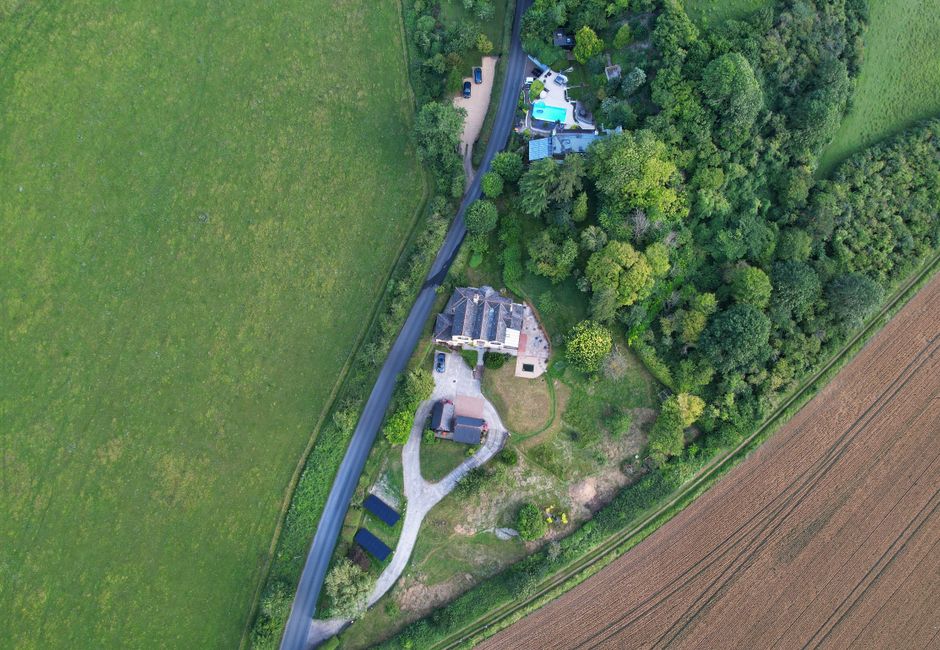
Horizontal loops are buried at a depth of 1–2 metres across a wide area of ground. They’re cheaper to install than boreholes because no specialist drilling equipment is needed — just an excavator and trenching. The rule of thumb is that you need approximately 10 metres of pipe per 1 kW of heat pump output, in a plot that isn’t paved, built upon, or heavily shaded by trees (shade reduces the ground’s ability to regenerate heat from solar gain). For a 10 kW system, that means roughly 500–700 metres of pipe spread across perhaps 300–500 m² of garden — around the size of six tennis courts. It’s a lot. Smaller properties with enough land often use slinky coil configurations to fit more pipe length into a smaller area, though this reduces thermal performance slightly.
Boreholes
Where garden space is limited, vertical boreholes are drilled to depths of 80–150 metres. Each borehole can extract approximately 50–80 W per metre of depth, so a 10 kW system typically needs 2–3 boreholes of 100 metres each. Drilling costs £8,000–£15,000 per borehole depending on geology and location, which is why borehole GSHPs are significantly more expensive than horizontal loop installations. The upside: once drilled, boreholes have a lifespan of 50+ years and require virtually no maintenance.
Ground source heat pump costs in 2026
GSHP costs vary widely depending on the ground loop type, the required heat pump capacity, and local geology and labour rates. The figures below are indicative 2026 UK costs, covering the heat pump unit, installation labour, ground loop/borehole, and associated system work (cylinder, controls, electrical connections).
Installation type
Typical cost range (2026)
BUS grant (£7,500)
Net cost after grant
Typical home suited
Horizontal ground loop, 6–8 kW
£15,000 – £22,000
£7,500
£7,500 – £14,500
3-bed, large garden (300m²+)
Horizontal ground loop, 10–12 kW
£20,000 – £28,000
£7,500
£12,500 – £20,500
4–5 bed, large rural plot
Single borehole GSHP, 6–8 kW
£20,000 – £30,000
£7,500
£12,500 – £22,500
3–4 bed, limited garden
Twin borehole GSHP, 10–14 kW
£28,000 – £45,000
£7,500
£20,500 – £37,500
Larger home, clay/limestone geology
These are significantly higher than air source heat pump costs, which run £8,000–£15,000 installed. Whether the extra investment makes sense depends on your heating fuel (GSHPs offer particularly strong returns replacing oil heating), available land, and how long you plan to stay in the property. Our heat pump costs guide covers ASHP and GSHP costs side by side.
GSHP vs ASHP: which is right for your home?
For most UK homeowners, an air source heat pump is the more practical choice. Ground source makes sense in specific circumstances. This comparison covers the key differences:
Factor
Ground source (GSHP)
Air source (ASHP)
Typical installed cost
£15,000 – £45,000
£8,000 – £15,000
BUS grant
Yes — £7,500
Yes — £7,500
Typical SCOP (UK)
4.0 – 5.0
2.8 – 3.8
Land requirement
Large garden (horizontal) or borehole
Small external space for unit
Noise
Very low — unit is indoors
Low to moderate — outdoor unit
Performance in cold weather
Stable — ground stays at ~10°C
Falls with air temperature
Visual impact
None visible externally
Outdoor unit visible
Planning permission (typically)
Permitted development (ground loop); borehole may vary
The Boiler Upgrade Scheme for ground source heat pumps
GSHPs qualify for the Boiler Upgrade Scheme (BUS) grant of £7,500 — the same amount as air source heat pumps. The grant is paid directly to your MCS-certified installer and deducted from your invoice, so you simply pay the remaining balance. Given the higher overall cost of GSHP installations, the grant represents a smaller percentage of total cost than for air source, but it’s still a meaningful contribution.
Eligibility requirements are the same as for air source: the property must be in England, Scotland, or Wales; the existing EPC must not have outstanding recommendations for loft or cavity wall insulation; and the installer must be MCS-certified. Read our heat pump grants guide for the full eligibility criteria and how to apply.
Planning permission for ground source heat pumps
In most cases, GSHP installations fall under permitted development in England — meaning no planning application is required. However, there are exceptions. If your property is in a conservation area, is a listed building, or sits in an Area of Outstanding Natural Beauty, you may need prior approval or full planning permission for groundworks. Boreholes are generally treated as permitted development regardless of planning designation, but it’s worth confirming with your local planning authority before committing to a borehole installation.
In Scotland, the permitted development rules are set by Scottish Planning Policy. Wales follows its own planning framework. Your MCS-certified installer should be able to advise on local requirements — this is another reason to verify MCS certification via mcscertified.com before proceeding.
Photo: Pavel Danilyuk / Pexels
GSHP efficiency: why the ground loop matters
The UK ground temperature at 1–2 metres depth sits at around 8–12°C year-round — warmer than winter air, cooler than summer air. This means a GSHP’s heat source is never as cold as the air on a January morning, and its performance doesn’t suffer the dramatic winter efficiency drop that air source pumps experience. The result is a more stable seasonal CoP — typically 4.0–5.0 across the year for a well-designed GSHP installation versus 2.8–3.8 for a comparable air source system.
The Heat Pump Association notes that GSHP efficiency advantage is most pronounced in colder regions — Scotland, upland areas of northern England — where winter air temperatures fall further below zero. In milder southern England, the efficiency gap between a well-installed ASHP and GSHP narrows considerably.
Ground loop sizing and thermal regeneration
Ground loops must be sized carefully to avoid extracting heat faster than the ground can regenerate it. An undersized ground loop causes the soil temperature around the pipes to fall over successive winters, reducing efficiency year-on-year. This is why the “10m of pipe per kW” rule of thumb is a starting point only — a specialist GSHP designer accounts for local soil thermal conductivity, the heating degree days in your location, and the proportion of the year the system will be operating.
Best scenarios for a ground source heat pump
A GSHP is most likely to be the right choice when several of the following apply:
You’re replacing oil or LPG heating. The running cost savings versus oil or LPG are substantial — typically £700–£1,500/year based on current fuel prices — and the higher upfront GSHP cost is more easily justified than when replacing gas.
You have a large rural plot. If you have 400 m² or more of unpaved, unshaded land available, a horizontal ground loop avoids borehole costs and brings total installation cost closer to £15,000–£22,000.
Noise is a concern. The GSHP compressor is housed indoors — often in a utility room, plant room, or garage — with no outdoor unit. This makes GSHPs the quietest option and eliminates any neighbour or planning concerns about noise.
You’re in Scotland or upland northern England. Longer, colder winters make the GSHP’s performance stability more valuable and increase the accumulated efficiency advantage over air source.
You’re building a new home. Integrating a ground loop during construction is far cheaper than retrofitting it later, and new-builds designed around low-temperature heating systems (underfloor heating, high insulation) maximise GSHP efficiency.
When a ground source heat pump is not the right choice
Be honest with yourself here. GSHPs are not universally superior, and for many UK homeowners, the extra cost is hard to recoup:
Urban or suburban homes with small gardens. If you don’t have the land for a horizontal loop, you’re looking at boreholes — which add £15,000–£30,000 to the cost. For a typical city terrace, an air source heat pump is almost always the more sensible choice.
Replacing gas central heating in a mild region. The efficiency premium of GSHP over a well-installed ASHP in southern England may not justify an extra £10,000–£20,000 in upfront cost within any reasonable payback period.
Homes needing significant other work. If your home needs major insulation upgrades, new radiators, or rewiring, adding borehole costs on top can make the total project financially unviable. An ASHP with phased improvements is often a better sequenced approach.
Uncertain tenure. If you’re planning to move within 5 years, the higher upfront GSHP cost is unlikely to be recovered in the sale price premium — though a certified installation will add value.
Maintenance and lifespan
GSHPs have a reputation for reliability, and it’s mostly warranted. The heat pump unit itself needs an annual service — checking refrigerant pressure, electrical connections, and controls — much like an air source system. The ground loop requires essentially no maintenance once installed. Borehole installations, with no moving parts in the ground, can last 50–100 years. Horizontal ground loops typically last 50+ years as well, though waterlogged or acidic soils can degrade pipe materials over very long periods.
Antifreeze in the ground loop should be checked and refreshed periodically — typically every 5–10 years, depending on loop volume and antifreeze type. This is a minor service item. The heat pump compressor unit has a typical lifespan of 20–25 years with proper servicing. Replacement at end of life would involve swapping the indoor unit only, with the ground loop remaining in place — a significant cost saving over an equivalent air source replacement that requires a new outdoor unit.
Photo: Altaf Shah / Pexels
The bottom line on ground source heat pumps
GSHPs offer genuinely superior efficiency and stability, particularly in cold climates and for homes with high heat demand. But the cost premium is real and the land requirement is significant. For rural homeowners with large plots replacing oil or LPG heating, a GSHP often makes strong economic sense. For urban homeowners with average-sized gardens replacing gas, an air source heat pump will usually deliver better value for money.
Whatever route you choose, start with a proper heat loss assessment, check your suitability using our heat pump suitability checklist, and get at least three quotes from MCS-certified installers before committing. Use our savings calculator to model the financial return for your specific home and heating fuel. And read our full guides library for everything else you need to make a confident decision.